Location
Nyamagabe District, RWANDA
Grantee
Leonce Hirwa
Project
The Pride in Periods Initiative
Leonce Hirwa
Leonce Hirwa is a 25-year-old medical student and the founder of The Pride in Periods Initiative, a grassroots menstrual health program based in Rwanda’s Nyamagabe District. Growing up, he watched girls disappear from school for days every month, kept home by shame and a lack of supplies, and no one talked about it. Years later, a single conversation with a young patient during his clinical rotations — “I feel dirty when I bleed” — convinced him the silence had to end. Through the Pride in Periods Initiative, he has led a volunteer team of fellow medical students to bring menstrual health education, reusable pads, and open conversation to schools that had never had either.
What the seed grant made possible
4,800
girls received menstrual health education
3,600
boys trained to understand and support their classmates
450
reusable sanitary pads distributed to girls who had none
8,450
people directly impacted in total, across 12 schools
The Project
As a boy growing up in Rwanda, Leonce Hirwa watched girls vanish from school for days every month — some using rags, others simply staying home, weighed down by shame no one would name out loud. Years later, during his clinical rotations as a medical student, that same silence followed him into examination rooms, until one patient’s words changed the course of his work: “I feel dirty when I bleed.” “No one should feel ashamed of something so natural,” Leonce says. “This project is my response — to educate, uplift, and restore dignity.”
That response became The Pride in Periods Initiative, a grassroots menstrual health education program bringing reusable sanitary pads and life-changing knowledge to schoolgirls across Nyamagabe District — and a $500 seed grant from The Pollination Project’s Daily Grant Program gave it the resources to begin.
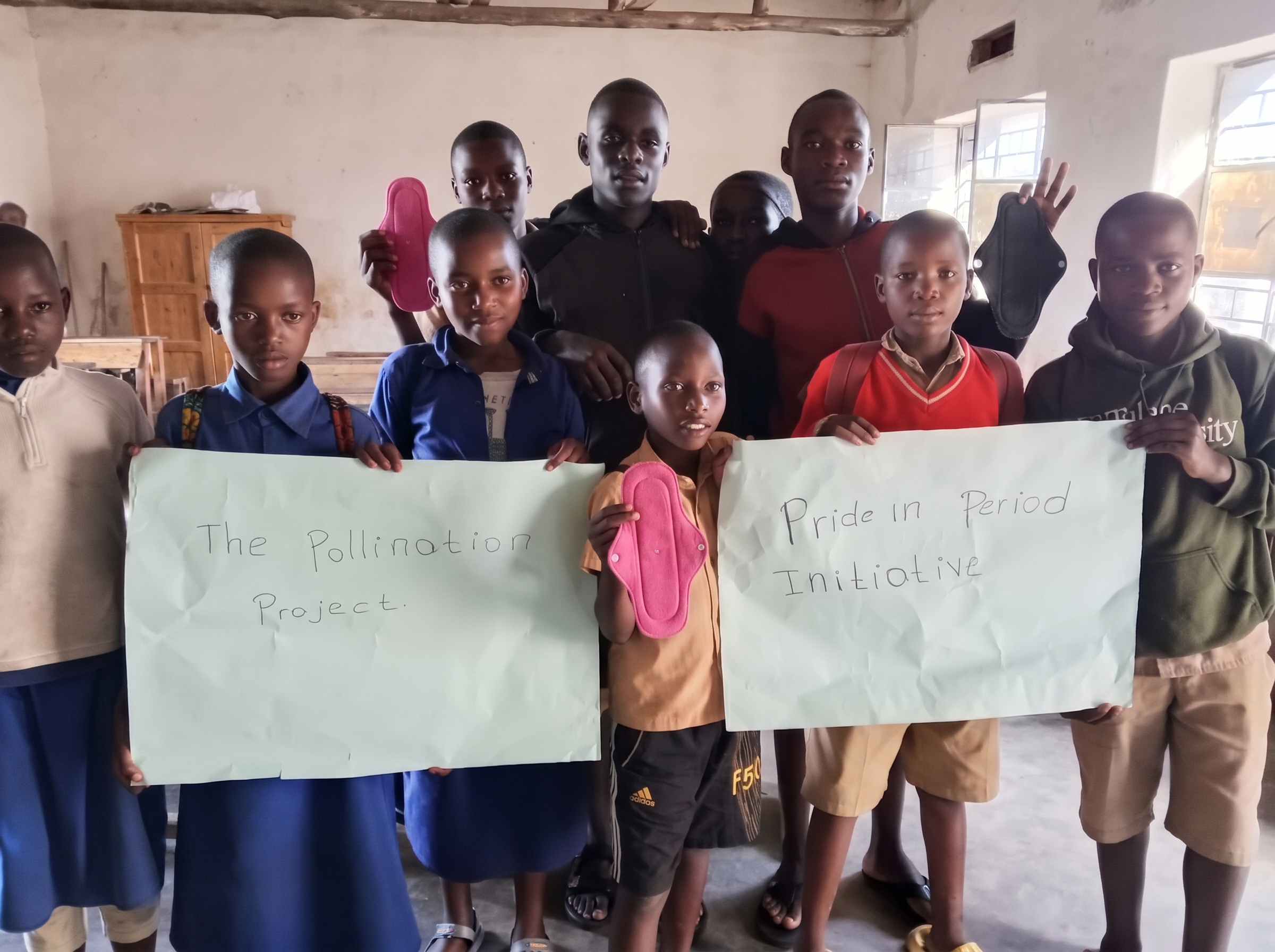
Leonce and a team of medical student volunteers set out planning to visit a handful of schools. They ended up reaching 12: G.S Uwinkomo, G.S Murico, G.S Gikongoro, EP Ruganza, EP Muse, G.S Gasaka, G.S Kigeme, G.S Munini, G.S Mbazi, G.S Kitabi, G.S Kinyana, G.S Kibumbwe, and G.S Kiyumba. The grant funded soft cotton fabric and waterproof lining for reusable pads, sewing materials, workshop handouts and printed awareness brochures, handwashing soap and sanitizer, teaching materials, local transportation for outreach visits, and internet bundles for coordination — every dollar stretched toward putting girls at the center.
The program was built around a simple idea: ending period stigma takes everyone. Girls learned to manage their periods safely, make and care for reusable pads, and understand their own bodies. Boys attended parallel sessions where they learned about menstruation, challenged teasing behaviors, and committed to supporting their classmates. Teachers received separate training so the conversations would continue long after the volunteers left. Pre- and post-workshop quizzes confirmed real gains in knowledge across all 12 schools, and girls reported feeling less ashamed and more confident.
The road wasn’t smooth — heavy rains turned roads to mud, forcing volunteers to walk long distances or ride motorbikes on slippery paths, and low light and understandable shyness made photography difficult. Every planned activity was still completed. The initiative caught the attention of MEDSAR, the Medical Student Association of Rwanda, which contributed additional funding for volunteer transport and more reusable pads — recognition that the work resonated far beyond Nyamagabe District.
Having reached over 20 times the number of girls Leonce originally promised, the initiative isn’t stopping here. Next steps include follow-up visits to the 50 trained teachers, fundraising for more reusable pads, and expansion into two additional districts. “We promised 400 girls,” Leonce reflects. “We reached 8,450 people. We learned that even small resources, when used with heart, can change a community.”